


28 April 2026
You Don’t Need More Motivation — You Need a Better Strategy
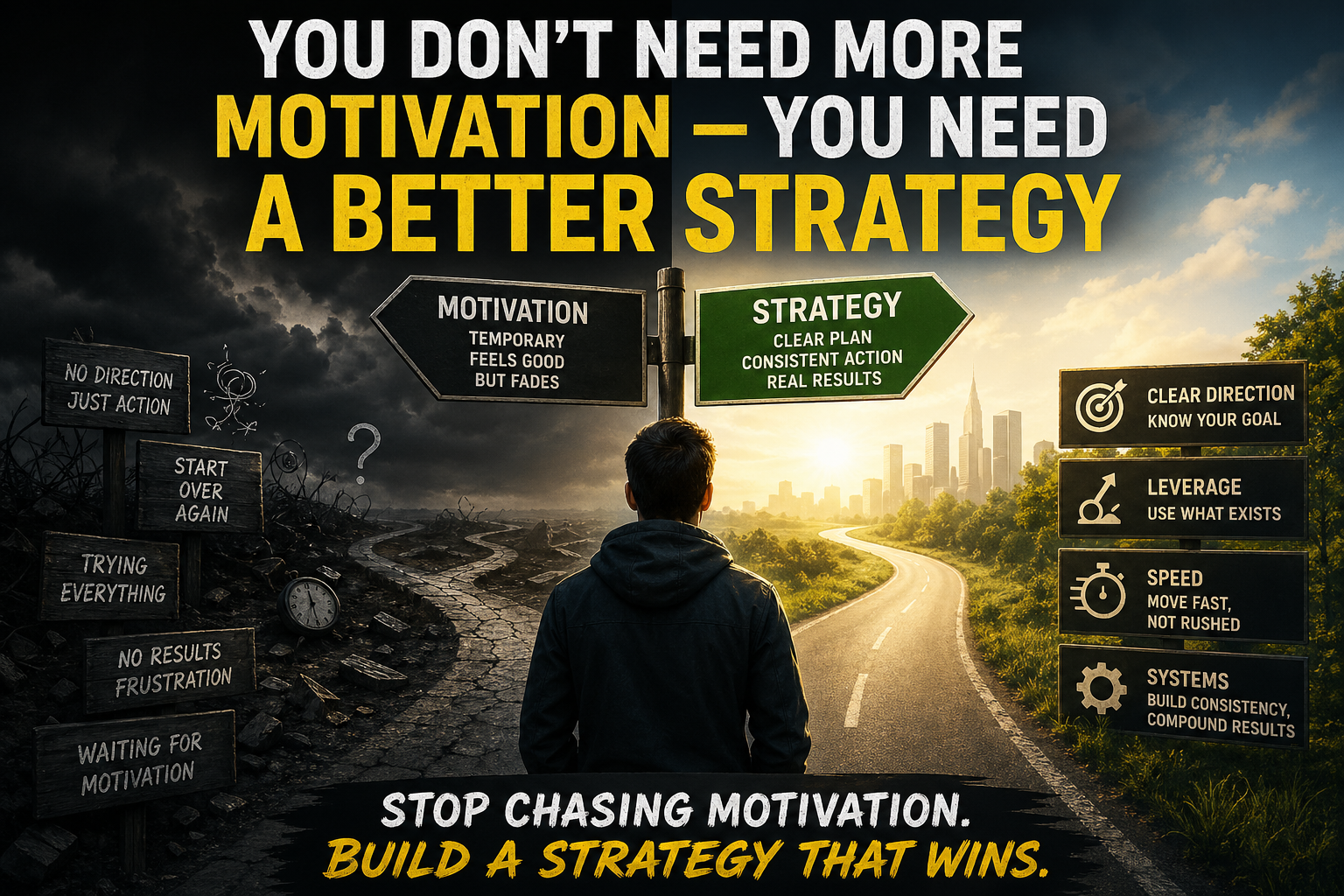
Motivation Isn’t Your Problem. Stop Blaming It.
Let’s be honest.
You’re not stuck because you lack motivation.
You’ve had it.
Plenty of times.
That late-night spark.
That “this time I’m serious” energy.
That surge of determination where everything suddenly feels possible.
And yet… nothing really changes.
You start. You push. You try.
Then it fades.
Again.
So you go looking for more motivation—another video, another quote, another boost.
But here’s the uncomfortable truth:
Motivation isn’t the engine. It’s just the ignition.
And you’ve been trying to drive a car that was never properly built in the first place.
The Problem With Motivation Nobody Talks About
Motivation feels powerful.
That’s exactly why it’s so dangerous.
It fades faster than you expect
Motivation is emotional. And emotions don’t last.
You wake up tired.
You hit resistance.
Something doesn’t work.
Suddenly, that “I’m going all in” mindset disappears.
Not because you’re weak.
Because motivation was never meant to carry the load.
It doesn’t produce results on its own
Being motivated doesn’t mean you’re moving in the right direction.
It just means you’re moving.
And movement without direction?
That’s just noise.
You can spend hours working, posting, building, tweaking… and still end up exactly where you started.
Why?
Because effort without structure doesn’t compound.
It traps you in cycles
This is where most people get stuck.
They wait until they feel motivated.
They take action.
They burn out.
They stop.
Then they wait again.
It becomes a loop.
A frustrating, invisible loop that feels like progress—but isn’t.
You don’t need more motivation to break that cycle.
You need something far more uncomfortable.
What You’re Actually Missing: Strategy
Let’s strip it down.
If you’re not getting results online, it’s rarely because you’re lazy.
It’s because you don’t have a clear, effective plan.
Not a vague idea.
Not a “try everything and see what works” approach.
A real strategy.
Because strategy does what motivation never can:
It gives your actions direction, structure, and purpose.
What a Real Strategy Actually Looks Like
Strategy isn’t complicated.
But it is deliberate.
And most people avoid it because it forces them to think before they act.
Here’s what separates real strategy from random effort:
1. Clear Direction
You know exactly what you’re trying to achieve.
Not “make money online.”
That’s not a goal—that’s a wish.
A real direction looks like:
- A specific market
- A defined outcome
- A clear path to get there
When you have direction, you stop guessing.
You stop jumping between ideas.
You stop restarting.
2. Leverage
This is where most people get it wrong.
They try to build everything from zero.
Zero audience.
Zero assets.
Zero systems.
That’s not noble.
It’s inefficient.
Leverage means using what already exists:
- Existing platforms with traffic
- Tools that automate work
- Digital assets that shortcut time
- Proven systems instead of reinventing everything
Smart people don’t do more work.
They use better starting points.
3. Speed
Not rushing.
Not cutting corners.
Speed is about reducing unnecessary delay.
The digital world moves fast.
Trends shift. Markets evolve. Opportunities close.
If your approach takes months just to get started, you’re already behind.
Strategy forces you to prioritize:
- What matters now
- What can be skipped
- What can be accelerated
Because slow, perfect plans lose to fast, effective execution.
4. Systems
This is where consistency comes from.
Not discipline. Not motivation.
Systems.
A system is something that works even when you don’t feel like it.
- Content pipelines
- Sales funnels
- Automation tools
- Repeatable workflows
Without systems, you rely on effort.
With systems, you build momentum.
The Real Difference: Motivation vs Strategy
Let’s make it simple.
The motivated but directionless person:
- Jumps from idea to idea
- Starts from scratch every time
- Relies on energy to stay consistent
- Works hard… but inconsistently
- Gets frustrated quickly
They’re busy.
But they’re not progressing.
The strategic, system-focused person:
- Chooses one direction and commits
- Builds on existing assets and platforms
- Uses systems to stay consistent
- Moves quickly but with purpose
- Adjusts based on results, not feelings
They’re not always motivated.
But they’re always moving forward.
That’s the difference.
Strategy Changes Everything
Once you shift from motivation to strategy, things start to click.
Not overnight.
But consistently.
You make better decisions
You stop chasing trends blindly.
You evaluate:
- Does this fit my direction?
- Does this move me forward?
If the answer is no, you skip it.
That alone saves you months of wasted time.
You move faster
Because you’re not constantly restarting.
You’re building on what already exists.
Every step compounds.
Every move connects.
You waste less effort
You’re not doing random tasks hoping something works.
You’re executing a plan.
Even small actions start producing results.
What Strategic Moves Actually Look Like
This is where things become real.
Strategy isn’t theory—it shows up in how you operate.
Here are examples of smart, ethical moves people are making right now:
Using existing platforms instead of building from zero
Instead of creating a website and hoping for traffic…
They start where traffic already exists:
- Marketplaces
- Social platforms
- Established ecosystems
They plug into demand instead of trying to create it from scratch.
Leveraging tools to automate repetitive work
Instead of manually doing everything…
They use:
- Scheduling tools
- Automation systems
- Analytics platforms
Less effort. More output.
Working with existing demand
Instead of guessing what people want…
They look at:
- What’s already selling
- What’s already trending
- What people are actively searching for
Then they position themselves inside that demand.
Using digital assets strategically
This doesn’t mean shortcuts or cutting corners.
It means recognizing that time is valuable.
People use:
- Templates
- Pre-built systems
- Established frameworks
Not to cheat—but to move faster and smarter.
Why Most People Avoid Strategy
If strategy is so powerful, why doesn’t everyone use it?
Because it’s uncomfortable.
It requires thinking before acting
Most people would rather do something than plan something.
Planning feels slow.
Action feels productive.
Even when it’s not.
It’s less exciting than motivation
Motivation gives you a rush.
Strategy gives you structure.
One feels good.
The other works.
It exposes mistakes
When you think strategically, you start seeing gaps:
- Weak ideas
- Poor positioning
- Inefficient approaches
That can be uncomfortable.
But it’s also where growth happens.
Where Digital Marketplaces Fit In
This is where things get practical.
Digital marketplaces aren’t magic solutions.
But they are powerful tools when used correctly.
They provide:
- Access to existing demand
- Opportunities to leverage ready-made assets
- Environments where speed matters
Instead of building everything from zero, you can:
- Enter active markets
- Test ideas quickly
- Scale what works
It’s not about shortcuts.
It’s about reducing unnecessary friction.
Used strategically, these platforms become part of your system—not your entire strategy.
The Shift That Changes Everything
Here’s the realization most people avoid:
You don’t need to feel ready.
You need to be structured.
Motivation comes and goes.
That will never change.
But strategy?
That’s something you control.
Final Thought: Stop Waiting to Feel Different
You’ve been told that success comes from staying motivated.
It doesn’t.
It comes from building something that works even when you’re not.
So instead of asking:
“How do I stay motivated?”
Start asking:
- What’s my direction?
- Where can I use leverage?
- How can I move faster?
- What systems can I build?
Because once you answer those questions, something shifts.
You stop chasing energy.
You start building momentum.
And that’s when results finally show up.
Not because you felt like it.
But because you built something that works.


